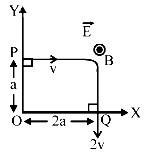
A charged particle of mass 'm' and charge 'q' moving under the influence of uniform electric field
E and a uniform magnetic field
B follows a trajectory from point P to Q as shown in figure. The velocities at P and Q are respectively,
v and
−2v. Then which of the following statements (A, B, C, D) are the correct ? (Trajectory shown is schematic and not to scale) :
(A)
E=()(B) Rate of work done by the electric field at P is
()(C) Rate of work done by both the fields at Q is zero
(D) The difference between the magnitude of angular momentum of the particle at P and Q is 2 mav.
 (A)
(A)